
Archery is one of the three “manly games” showcased at Naadam, and one of two in which women participate. Witness this festival firsthand during a special departure of Mongolia & the Gobi Desert.
Refer Friends & Earn Cash Rewards—Up to a FREE Trip.
Archery is one of the three “manly games” showcased at Naadam, and one of two in which women participate. Witness this festival firsthand during a special departure of Mongolia & the Gobi Desert.
Question: The opening ceremony of Mongolia’s annual Naadam festival features a parade of nine white banners made of what?
Answer: Horse tails
To mark the official opening of Mongolia's annual Naadam festival, a nationwide celebration of traditional nomadic culture, an honor guard on horseback parades into Ulaanbaatar’s National Stadium hoisting nine banners crafted from the tail hairs of a thousand white stallions. Called the Yuson Kholt Tsagaan Suld, or Nine White Spirit Banners, the horsehair banners attached to poles are among the most sacred symbols of Mongolian statehood and heritage—and, just like Naadam itself, are deeply associated with the legacy of Genghis Khan.
When Temujin, later known as Genghis Khan, unified the Mongol tribes in 1206, he was declared the Great Khan of the Mongols under Nine White Horsehair Banners, each representing one of the major Mongol tribes. Symbols of power and peace, the white banners were carried during peace negotiations as Khan and his Mongol army swept across Asia on their way to establishing the largest land empire in history.
But woe to opponents who were met with black banners instead of white ones. Symbols of strength, aggression, and a divine sanction for battle, black banners were raised when the Mongols were going to war. Historically, the presence of both white and black banners reflected the dual role of the Khan—as both a peacemaker and a warrior.
Now that we know what the Nine White Banners are all about, let’s look at how Naadam itself is deeply rooted in the Mongol Empire ...
Genghis Kahn and the origins of Naadam
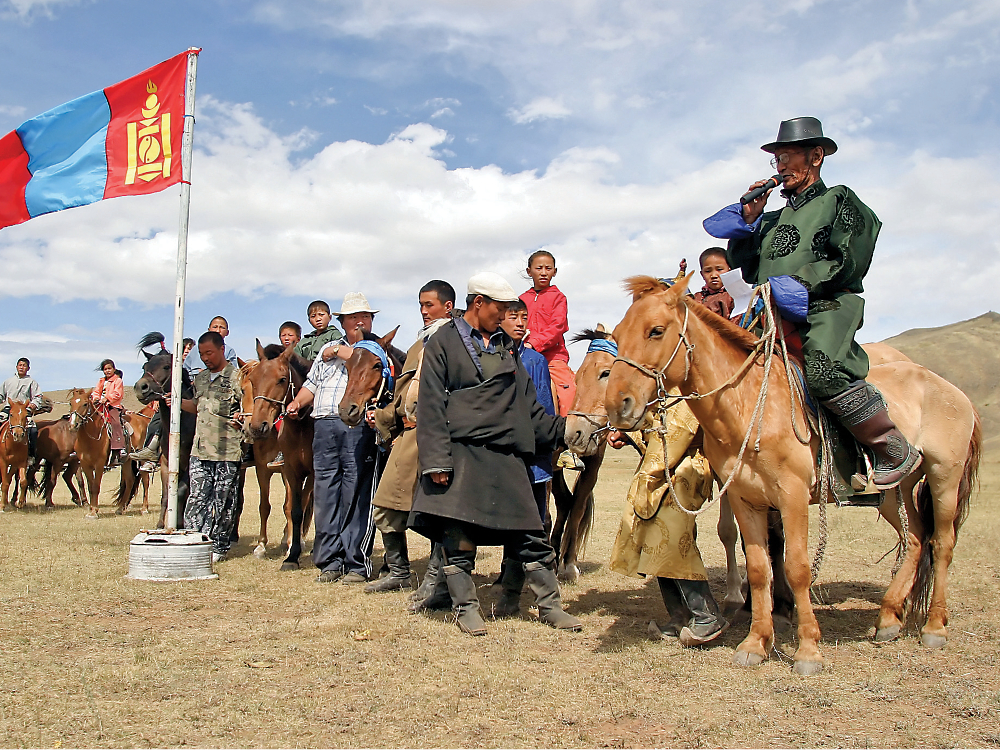
Genghis Khan’s Mongols were renowned for their superior military skills. Warriors were chosen based on their strength, movement, and flexibility, qualities that were tested in sporting trials. Wrestling and archery would reveal their hand-eye coordination, and horse racing would test their bravery in battle. Used both to train the military and as a celebratory event following the defeat of Mongol enemies, this trio of sporting events—archery, horse-racing, and wrestling—became known as Eriin Gurvan Naadam, or the Three Manly Games.
Naadam flourished as a nationwide festival until Mongolia fell under the rule of the Qing Dynasty (between the 17th and 20th centuries), who wanted to disrupt the unity of Mongolians by limiting participation in traditional sports in mass events like Naadam. After the fall of the Qing Dynasty in 1911, Mongolia declared its independence in 1921 and Naadam was officially resurrected. But while Naadam was now a national holiday, independence itself was short-lived as Mongolia came under the thumb of the Soviet Union for the next 70 years. In 1990, a peaceful democratic revolution finally dismantled the communist regime and Mongolia transitioned to a modern Democracy in 1992.
Today, Naadam has become the largest gathering in Mongolia, a nationwide celebration of traditional nomadic culture and heritage through an exhibition of a trio of sports with direct links to Genghis Khan and the Mongols ...
The three manly games of modern-day Naadam
With nomads using bows and arrows for hunting, archery has always played an important part in Mongolian life. But it was the ability of Khan’s Mongol army to rain arrows on its enemies while on horseback that made them the most feared warriors across the steppes and beyond. The archery competition held during Naadam may be “manly,” but it’s also open to females and children archers. A test of strength, vision, and concentration, the contest is broken into three categories–Khalkh, Buriad, and Uriankhai—featuring different bows, arrows, and distances to the target.
But in general, men use compound bows made with sinew, wood, horn, and bamboo, and strung with bull tendon. They shoot 40 arrows made from willow branches and griffin vulture feathers from a distance of 246 feet (75 meters). Women deliver 20 arrows from 197 feet (60 meters) at a target. Reflecting centuries-old traditions, several men (perhaps we should say “brave” men) stand on either side of the target singing a folk song to cheer the contestants on, and use hand signals to indicate the results. The targets are called surs, which are small, stacked cylinders that create a wall that competitors have to knock out with their arrows. The winners are given the titles of “national marksman” and “national markswoman.”
The second manly game once wrestled with a scandal
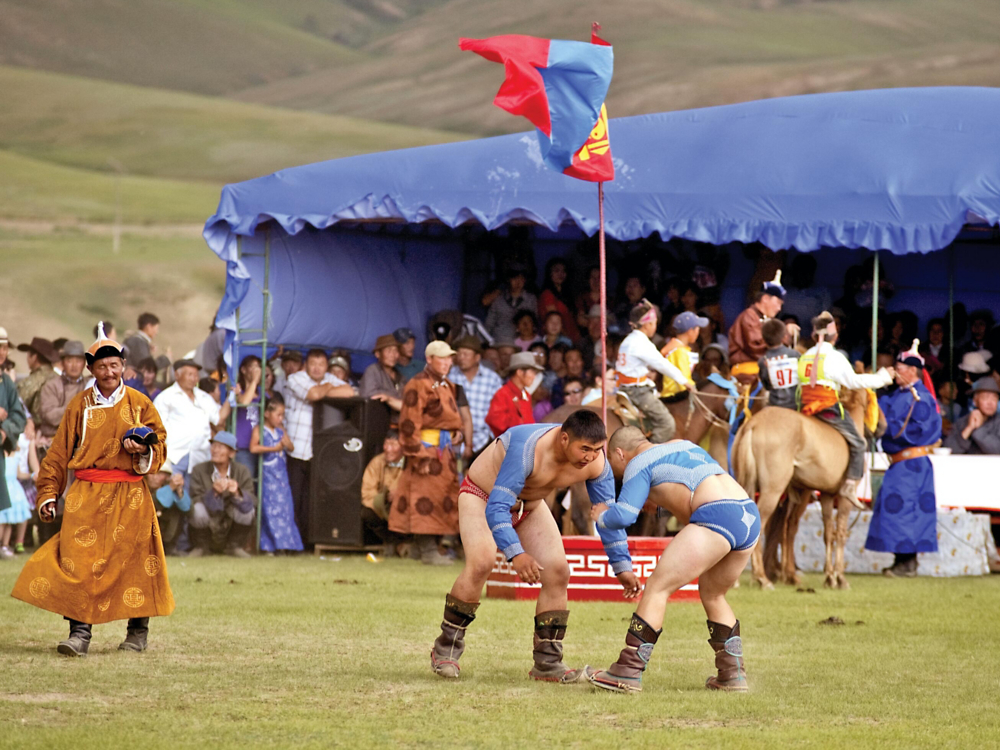
The most iconic Mongolian garment during Naadam—worn by both men and women—is the deel, a colorful tunic-like robe crafted from cotton, wool, or silk that is fastened at the right side with decorative clasps. The deel is worn by everyone at Naadam—except wrestlers. Historically, Mongolian wrestling attire fully covered the chest. But according to Mongolian folklore, a female Amazonian warrior once entered the competition disguised as a man. Outperforming her male counterparts, she won the tournament, shocking the spectators.
To prevent this from happening again, the traditional wrestling vest—called a zodog—was redesigned to be completely open at the chest, ensuring that only men could compete. The resulting uniform, worn to this day by wrestlers at Naadam, consists of the now “open-chested” zodog, along with tight-fitting red or blue shorts (called shuudag), a symbolic four-sided hat, and traditional boots and cloak.
Needless to say, then, the wrestling event at Naadam is open to men only. There are no weight classes, and men compete in a single-elimination tournament where a match is lost when any part of the body other than hands or feet touches the ground. Wrestlers enter the field doing an eagle dance, which has them flapping their arms like an eagle. Then, they crouch down slapping the fronts and backs of their thighs, to show their strength and power. With no age limits, no time limits, and no size limits, the bouts can result in a few David and Goliath moments, with wiry guys sometimes getting the best of slower behemoths. Matches typically go on for 9 or 10 rounds, and the winner celebrates with a victory eagle dance. Next, we’ll saddle up for the final major competition in Naadam ...
The manly sport of horse racing—mere child’s play in Mongolia
They say Mongolia is a nation born on horseback. Horses are such an ingrained part of Mongol nomadic culture, it should be no surprise that children begin riding as young as three or four years old—and some are in the saddle at the age of one. But the competitors in the Naadam horse-racing event are between five and 12 years of age, racing between six and 18 miles along in the open countryside (the length is dependent on the age of the horses and has nothing to do with the age of the riders!). Thousands of spectators cheer on the youngster sitting confidently astride their small, sturdy Mongolian steeds racing along the plains—possessing some of the same equestrian skills that enabled Genghis Khan to build an empire stretching from the Sea of Japan all the way to Europe.
A crowd favorite is a competition featuring identical horses and riders, who race in perfect sync, with winners receiving a medal, cash, and sometimes a live goat for dinner. Winning horses in other races are recognized with a poem praising their looks and strength. The horse who finishes last is also praised for its underwhelming performance and is given encouragement for a better performance in the upcoming years. In all fairness, it should be mentioned that while this sport is an important part of Mongolia’s heritage, the age of the riders has attracted a bit of criticism in recent years, prompting the government to consider revising the regulations to improve safely standards. Then again, what would Genghis do?
A Few More Fascinating Facts about Naadam and Mongolian Culture
Witness the enduring traditions of Naadam in 2027 during a special departure of Mongolia & the Gobi Desert.
Playing with Purpose in a "Magical Land": Mongolia’s Science Playground
See how the Foundation is fostering a love of learning through an innovative science playground.
Teatime in the Cemetery of Dragons
Learn about the history of the tea road from Munkhbat Muuggi Batbekh— Trip Experience Leader for O.A.T.’s Mongolia & the Gobi Desert adventure.
Lessons from the Wrestling Ring: Uugan-Erdene on Mongolia's Beloved Sport
Through the eyes of Uugan-Erdene Khurtsgerel—a passionate Mongolian wrestler and O.A.T. Trip Experience Leader—discover how Mongolian wrestling continues to shape Mongolia's cultural identity and inspire generations as a cornerstone of the Naadam Festival.
Get The Inside Scoop On...
Like what you see here? Receive weekly updates right in your inbox.
inside-scoopArticles In This Edition

Beyond the Trends: Undiscovered O.A.T. Adventures

A Ship Out of Water

Banner Celebration

Cemeteries and Celebrations in Northern Argentina and Chile

From Rehearsal to Revelry: Inside Rio’s Carnival

Glad to Gather

No Nike, No Adidas … Just Amboseli

Top 10 Most Popular Journeys by Land, Sea & River