
Visit Chamonix at the foot of Mont Blanc during Alpine Europe: France, Italy's Dolomites, Switzerland & Austria.
Refer Friends & Earn Cash Rewards—Up to a FREE Trip.
Visit Chamonix at the foot of Mont Blanc during Alpine Europe: France, Italy's Dolomites, Switzerland & Austria.
Question: In 1838, Henriette d’Angeville, wearing a wool dress and stylish hat, became the first woman to summit what mountain?
Answer: Mont Blanc
On September 4, 1838, 44-year-old Henriette d’Angeville, stood atop Mont Blanc, becoming the first woman to summit Europe’s highest mountain. But she did more than that. Historically, mountaineering had been a “man’s world.” Henriette was told that ladies were not supposed to do “things like that.” But what really irked her was how men believed that they were the only ones capable of mountaineering. Henriette’s thinking was, if a man could do it, why couldn’t a woman? To make her point (and rub it in a bit), when she reached the top of Mont Blanc, she had her guides form a chair and she stood on top, thus making sure she had been higher up than any man before.
Henriette blazed a trail beyond mountaineering
As the first woman to summit Mont Blanc, Henriette inspired a generation of European women to take to the mountains in the decades that would follow—but there’s a slight qualifier to that (which we’ll get to shortly). For now, let’s just call her the first woman to stand atop the summit of ice-capped Mont Blanc, without assistance. She was certainly a trailblazer, and many consider her the first true female mountaineer.
Henriette d’Angeville came from a wealthy French aristocratic family—in fact, her grandfather was guillotined during the French Revolution. While Henriette kept her own head on her shoulders, she always dreamed of ascending Mont Blanc, which was located just a short distance from her family’s chateau in Geneva. She took long mountain hikes, knowing she would need to develop “sturdy” legs to meet the challenge to stay in shape. As the day of her planned climb approached, Henriette had some decisions to make. One was regarding clothing. Climbing a mountain or not, women in 19th-century France simply could not be seen in public wearing pants. Even the very few female mountain climbers of the era had to wear heavy woolen dresses with several layers of petticoats.
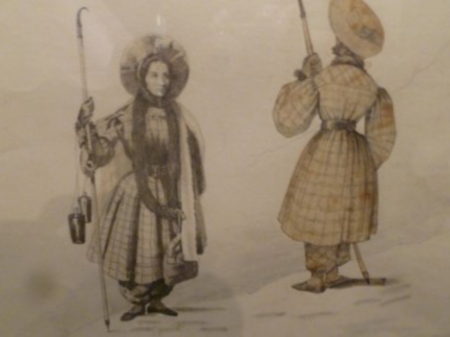
Whatever she came up with, Henrietta’s outfit was going to be more uncomfortable and less practical than the gear worn by male mountaineers of the day. She ended up designing her own climbing outfit, which included a large wool skirt, several petticoats, a stylish hat, hobnail boots, and a feather boa. Only when she was high up on the mountain–and well out of sight of the public, so as to not cause a scandal–did she swap her skirt for a pair of knickerbocker-style trousers that she had custom tailored to be more comfortable. Her outfit weighed 14 pounds, making her walk all the more difficult. Say what you will, the woman did have a flair for fashion ...
What about the rest of her supplies? Crampons didn’t really exist in 1838, so extra porters would often travel with climbing groups to cut steps in the ice. There were no mountain shelters on Mont Blanc like there are today, either, so if the weather changed suddenly, you were stuck. So, Henrietta took along six guides and six porters for the planned two- or three-day climb. Provisions included 24 roast chickens, 18 bottles of wine, two legs of mutton, two sides of veal, six loaves of bread, six pounds of chocolate, blankets and furs for spending at least one night at an altitude of 10,000 feet, two fans, a mirror (so she could straighten her hat), and a carrier pigeon.
If that seems rather extravagant and excessive, it was actually typical of packing by early mountaineers (at least the ones that could afford it, and Henrietta could). Remember, with no satellite phones or weather apps, groups had to make sure to bring along plenty of extra resources should they get stuck high up in a mountain. And bear in mind that Mont Blanc was—and still is—an extremely dangerous mountain. Even with today’s high-tech gear, dozens of climbers lose their lives each year attempting to summit Mont Blanc.
Because of the hazards involved in climbing this notoriously difficult mountain, no one really expected her to succeed. She had already made out her will after several friends and relatives warned her that her endeavor was dangerous, foolish, and unladylike. Local men in Chamonix even placed bets on the point at which she would abandon the climb. But she proved them all wrong.
Not surprisingly, her ascent of Mont Blanc was difficult. Like most of the men before her, Henrietta suffered from altitude sickness during the two-day climb. But she never thought about giving up. At one point when she was overcome by weakness, she told her guides that if she were to die, they should carry her to the top and leave her there. But she struggled along in a “state of agony” for the final four hours and finally stood atop Mont Blanc. Ignoring the conventions of the time, two of her guides lifted her into the air to pad her altitude by a foot or two for bragging rights. They popped Champagne to celebrate. And, long before the days of social media, Henriette quickly wrote some letters, strapping one on the carrier pigeon to send advance word of her accomplishment (bet you wondered what that carrier pigeon was for!). Before starting their descent, she famously engraved these words on a rock at the summit of Mont Blanc: "Vouloir, c'est pouvoir" (where there's a will there's a way).
Upon her return to the valley, a cannon was fired in honor of her achievement, followed by a celebratory dinner and gala. One of the guests to congratulate her was a woman named Marie Paradis, who had something in common with Henriette ...
The other woman who summitted Mont Blanc—30 years before Henriette
Henriette d’Angeville cuttingly remarked that she was the first woman to summit Mont Blanc who was “still capable of remembering her impressions.” She was referring to Marie Paradis, a local Chamonix girl who had reached the summit of Mont Blanc 30 years earlier. Marie had been convinced by some local guides that fame and glory awaited her if she reached the top—which she did, sort of. Miserable for most of the trek, Marie suffered dizzy spells, fainting, and shortness of breath. In the end, the guides would have to drag and sometimes carry her up the higher slopes to the summit. All she could remember about the climb was that “Everything around was white and down below was black.”
But Marie Paradis was the first to congratulate Henriette, making it clear that the honor of the first true female ascent of Mont Blanc belonged to her, not to Marie. “I was dragged, carried and pushed up there,” she admitted.
Henriette would become known as the “Bride of Mont Blanc,” and continued to conquer summits until the age of 69, proof that her passion for mountaineering was genuine and ahead of its time. She also made a point of taunting all those men in Chamonix who placed bets against her.
More fascinating facts about Henriette & female mountaineers
Discover the dramatic scenery that inspired mountaineers to reach new heights during Alpine Europe: France, Italy's Dolomites, Switzerland & Austria.
From the Matterhorn to Mordor
What mountain range was the inspiration for the Misty Mountains in J.R.R. Tolkien’s The Lord of the Rings?
Where in the World?
Where can you ride the world's slowest express train to the chalet-filled gateway of one of Earth's most distinctive peaks?
High Noon
Which iconic Alpine peak lets you "Step into the Void" and earned its name from the sun's daily journey across its summit?
Get The Inside Scoop On...
Like what you see here? Receive weekly updates right in your inbox.
inside-scoopArticles In This Edition

Autumn Leaving: Top 10 Most Popular Fall Journeys

Avenue of Volcanoes, Middle of the World

Climbing to Khufu: Bending to Eternity Inside the Great Pyramid

From the Matterhorn to Mordor

Putting Education Within Reach for Sherpa Students

Social Climber