Go far off the beaten path in the islands of Scotland’s Outer Hebrides and visit the favorite medieval church of Mark Mackenzie—Trip Experience Leader for O.A.T.’s Scotland Revealed: Legends, Lochs & Highland Landscapes adventure.
Far from the tourist-packed streets of Edinburgh and the well-trodden paths of the Scottish Highlands lies a landscape so remote and elemental that sheep often outnumber people. This is the Isle of Harris in Scotland's Outer Hebrides, which travelers can visit on The Gaelic Island Culture of the Scottish Hebrides: Skye, Lewis & Harris pre-trip extension to our Scotland Revealed: Legends, Lochs & Highland Landscapes adventure. Here, Mark Mackenzie—an O.A.T. Trip Experience Leader recently took us to discover one of his favorite historical sites in all of Scotland.
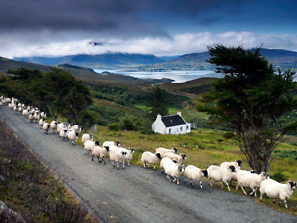
The drive took Mark approximately 45 minutes from Tarbert, the main settlement on Harris, with occasional stops to allow the free-roaming Hebridean blackface sheep to cross.
The Isle of Harris forms part of the Outer Hebrides—also known as the Western Isles—a chain of islands stretching some 130 miles off Scotland's west coast. Despite their size, these islands remain sparsely populated, with around 26,000 inhabitants total and fewer than 2,000 residing on Harris, or Na Hearadh in Gaelic. Unlike mainland Scotland, where the Gaelic language has largely disappeared as a community language with rare exceptions, many locals in the Hebrides still speak it daily.
At the beginning of his video tour (above), Mark navigates a single-track road with passing places along what locals call the "Golden Road" on the east coast, an area known as the Bays of Harris. The surrounding terrain resembles what Mark deemed a "moonscape"—stark and rocky, yet stunningly beautiful under blue skies and sunshine. His destination was St. Clement's Church in Rodel, a 16th-century structure that historians describe as "the grandest medieval building in the Western Isles."
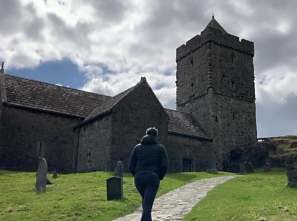
What makes the St. Clement's Church remarkable is not just its unexpected grandeur in such a remote location, but also its historical significance.
The church was commissioned around 1520 by Alistair Crotach McLeod, the eighth chief of the McLeods of Harris, whose nickname "Crotach" meant "humpback" in Gaelic. Alistair was buried there sometime between 1545 and 1547, his effigy displayed on one of the tombs.
Mark provides a thorough explanation of this effigy in the accompanying video (above), where he walks us through the stonework's fascinating carvings. These carvings represent elements important to McLeod in both life and death, including religious symbols of the Holy Trinity and, notably, a carving of a "birlinn" or Highland galley ship under sail.
In medieval times, the sea functioned not as a barrier but as a vital connection between communities. Visitors would have arrived at Rodel by sea rather than overland, making maritime power essential for clan chiefs. The birlinn galley was the main means of transportation and military might for Highland and Island lords, enabling them to move warriors quickly between islands and maintain control over their territories.
The church's dedication to St. Clement presents an intriguing historical puzzle. "Saint Clement is much more associated with sort of Danish seafaring influence," Mark explained in his video. "But there may be a connection there because there was a short period in the 11th century when the Hebrides were under Danish control."
Indeed, Clement—a leading figure in the early Christian church during the first century AD and the patron saint of mariners—is not typically venerated in Scottish religious tradition. This connection potentially reflects the brief Danish rule over the Hebrides in the 11th century, after which the islands became part of the Norse Kingdom of the Isles. This Norse influence continues to be evident in local place names and culture today.
Following the Protestant Reformation of 1560 (which saw Scotland break from the Catholic Church), St. Clement's fell into ruin. It was rebuilt more than two centuries later by Captain Alexander McLeod but suffered damage from fire shortly afterward. Though it hasn't functioned as a church for hundreds of years, it stands today as a remarkably preserved time capsule of the era of the McLeod chiefs.
The church now operates under the care of Historic Environment Scotland, open to visitors free of charge during the summer season (April to September), with limited winter hours as well.
Explore Stornoway—the capital of the Isles of Harris and Lewis—during The Gaelic Island Culture of the Scottish Hebrides: Skye, Lewis & Harris pre-trip extension to O.A.T.’s Scotland Revealed: Legends, Lochs & Highland Landscapes adventure.


