In the heart of Europe stand monuments that challenge our perception of sacred spaces: bone churches. These haunting sanctuaries, constructed from the skeletal remains of thousands—nobles, peasants, monks, and everyone in between—offer a stark glimpse into medieval attitudes toward death, spirituality, and the human condition.
The emergence of bone churches in Europe dates to the early Middle Ages, their origins rooted in surprising practicality. As Europe's population swelled throughout the medieval period—particularly in urban areas—existing cemeteries rapidly reached capacity. This predicament was exacerbated by the Christian tradition of burying the dead in consecrated ground—typically in churchyards—which were often limited in size.
The issue came to a head in the wake of cataclysmic events such as the Black Death in the 14th century, which resulted in a staggering number of deaths in a short period. The sheer volume of bodies overwhelmed existing burial practices, necessitating new approaches to handling human remains. Thus, the practice of secondary burial—wherein bodies were initially interred in the ground and later exhumed once decomposition was complete—became increasingly common. This process allowed for the reuse of burial plots while still maintaining respect for the deceased, whose bones would be carefully collected and stored.
As secondary burials happened more and more frequently, the stored bones began piling up—quite literally. Concurrently, medieval Christian theology placed great emphasis on the concept of memento mori—the reminder of death's inevitability. This dovetailed with the practical need for new burial solutions, giving rise to the idea of ossuaries that would not only solve space issues but also serve as powerful spiritual reminders.
Not-so-Humerous Reminders of Mortality
Indeed, theologically, these ossuaries served multiple purposes. They provided a poignant, visceral reminder of the inevitability of death and the transience of earthly life, encouraging viewers to contemplate their own mortality and focus on spiritual matters.
By mixing the bones of rich and poor, noble and common, bone churches emphasized the Christian belief in the equality of all souls before God. The careful preservation and display of bones aligned with the Christian doctrine of bodily resurrection, suggesting that these remains were being carefully tended until the Day of Judgment. In Catholic theology, the displays often served as reminders to pray for the souls of the deceased, potentially shortening their time in purgatory.
Culturally, bone churches reflected and influenced societal attitudes towards death. In an era of high mortality rates due to disease, war, and poor living conditions, these ossuaries helped normalize death as a part of daily life. They also served as communal memorials, connecting the living to their ancestors and to the broader history of their community.
Femur Fatale
The creation and maintenance of a bone church was a complex, long-term project that required significant labor and expertise. As you now know, the process began with the careful exhumation of bodies from existing graves. This was typically done after a set period, often 7-10 years, when soft tissues had fully decomposed. Once exhumed, the bones were meticulously cleaned. This often involved boiling or treatment with lime to remove any remaining tissue and disinfect the bones. In some cases, bones were bleached to achieve a uniform appearance.
After cleaning, bones were then sorted by type and size. Those in the best condition were selected for display, while damaged or fragmented bones might be stored separately or used in less visible areas. The actual construction of bone arrangements was a skilled task, often undertaken by monks or specialized craftsmen. Bones were carefully stacked, fitted together, and sometimes secured with wire or other fasteners to create stable structures. In many cases, the arrangement of bones went beyond mere stacking to create intricate patterns and designs—this required not only engineering skill but also artistic vision. Unsurprisingly, the entire process—from initial conception to exhumation to arrangement to ongoing maintenance—was deeply imbued with religious significance and typically accompanied by prayers and rituals.
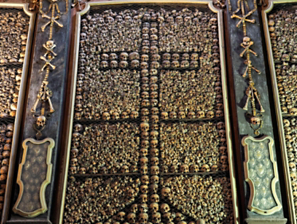
Bone churches certainly were an effective and artistic way to convey memento mori.
Once constructed, bone churches required regular maintenance. This included cleaning, repairing any damage, and sometimes rearranging bones as needed. In some cases, new bones were periodically added to the displays as more burials occurred and were subsequently exhumed. As these structures aged, preservation became a key concern. Many bone churches have undergone extensive restoration work to stabilize both the bones and the surrounding architecture.
"Tibia or Not Tibia?"
Bone churches vary widely in their specific designs, but they share several common structural elements that have become synonymous with their unique character. At their core, these ossuaries are typically constructed as traditional stone churches or chapels. The exterior often gives little hint of the extraordinary contents within, resembling other religious buildings of their respective periods and regions. The interior, however, is where the true distinctiveness of bone churches becomes apparent. The walls, ceilings, and sometimes even floors are decorated with carefully arranged human bones. These are not haphazardly placed but meticulously organized into patterns, designs, and even sculptural forms.
Long bones such as femurs and tibias are often stacked to create walls or partitions within the church. These can be load-bearing or purely decorative. Skulls are frequently arranged in alcoves or niches, creating a striking visual effect. These may be organized by size, shape, or even presumed age at death. Larger bones are sometimes used to construct arches or columns, mimicking traditional architectural elements. In some of the more elaborate ossuaries, bones are used to create intricate decorative features such as chandeliers, coats of arms, or religious symbols. Many bone churches include a crypt or underground chamber where additional remains are stored, often in a less ornate manner than the main display areas.
The overall layout typically follows that of a traditional church, with a nave, chancel, and sometimes side chapels. However, the usual church furnishings are often minimal or absent, with the bone arrangements taking center stage.
Explore the Capuchin Catacombs of Palermo during your free time to explore on our Sicily's Ancient Landscapes & Timeless Traditions adventure.


