
Read on to discover why you might not want to encounter this deceptively adorable species during Ultimate Australia.
Refer Friends & Earn Cash Rewards—Up to a FREE Trip.
Read on to discover why you might not want to encounter this deceptively adorable species during Ultimate Australia.
From koalas to kangaroos, Australia is a land of beautiful and iconic biodiversity. Whether you find yourself in Sydney, Cairns, or somewhere in the middle of this island continent, you’ll see unusual animals at every turn. Though some of them are fierce fiends and some are cuddly creatures, many are one-of-a-kind. Due to its geographic isolation, Australia has a high percentage of endemic species, organisms that are unique to a specific area and not found anywhere else in the world. Because of this, the country is filled with wonders that intrigue the rest of the world, and Australia remains a popular destination for wildlife lovers.
Quolls
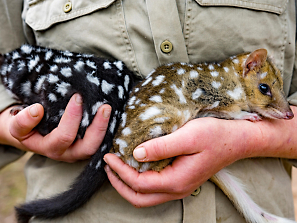
Have you ever wondered what a cross between a Tasmanian Devil and a cat would look like? Look no further than the quoll. These nocturnal, polka-dotted creatures, about the size of a small cat, are strikingly adorable, yet pack quite a punch. With a mouth full of sharp teeth, the quoll has one of the strongest bites by any predatory mammal in the world. Their small size and fast speed make them easily nomadic, and they tend to cover large distances most nights to keep safe and on the move. These creatures can be fierce when it comes to hunting, but their tiny pink nose and wide-eyed stare make them undeniably charming.
Some species of quoll give birth to babies the size of a grain of rice. And, depending on the species, one litter can have up to 30 pups in it, but it’s quite common that fewer than 10 survive. Like the kangaroo, quoll species either have a pouch or a pouch-like area that develops while pregnant to hold their young. After about five months, the young will reach independence and leave their dens. Once grown, these hand-held animals are still small but mighty.
Thorny Devil
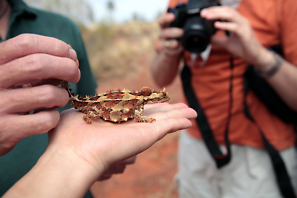
Though its name and appearance are frightful, the thorny devil is a relatively harmless lizard. This reptile, which can grow up to eight inches long, is a fascinating collage of red and tan scales, covered in spikes, and resembles a miniature dinosaur. Blending in with the sand of central Australia’s desert, this creature is an expert in camouflage and can run up to 40 miles per hour when being chased. Combined with its spiked skin and additional “false head” bump on the back of its neck, the thorny devil is a tough prey to catch. As a predator, this lizard only eats ants—and can eat multiple thousands a day.
The thorny devil is particularly unique for its distinctive features. One of these is that this desert-dweller can drink through its feet. You read that right! The thorny devil’s scaly exterior is full of micro-grooves and small channels, which collect water as they move about. Without any conscious thought, this water flows upwards toward their mouth. Similarly, rainwater collected on their backs operates the same way. The animal’s mating rituals are also unique. Female thorny devils tend to court males who walk unusually. Due to this, a male can be seen waving his legs, bobbing his head up and down, and altering his gait to attract a mate. To each their own, I guess!
Brolga
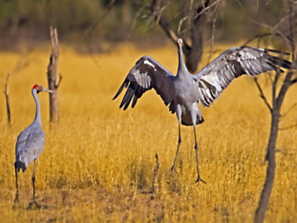
The brolga is Australia’s most cherished water bird. This member of the crane family is renowned for its dancing and elegance and can grow up to over 4 feet tall. Brolgas are found in hues of white and light gray, save for a bright red or orange patch on its head. These birds are also homebodies, and while they sometimes migrate northward, they usually stay in the same nesting areas for up to 20 years. Brolgas have strong family values, and after the breeding season is complete, they can form flocks of up to 100 birds. Plus, when eggs are hatched, both parents have an equal role of looking over them.
Brolga dancing displays are elaborate courting rituals. With their beaks pointed to the sky, synchronized jumping, and sprawled wings, brolga dancing almost looks like an elegant ballet performance. These displays happen during breeding season, in shallow marshes, which become their stage. The birds are thought to mate for life, and their dancing and loud trumpeting is a show of their strong bond—how romantic!
Echidna
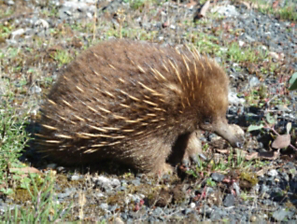
Also known as a “spiny anteater,” the echidna is an egg-laying mammal, or a monotremes, just like a platypus. These prickly pals resemble a hedgehog, but a few noticeable differences include their long noses and large feet with long claws. Echidnas are known for their digging, which comes in handy when predators are near or when looking for some tasty termites; it’s said that they can dig a hole as fast as a shovel. When hiding, they’ll quickly dig a hole and curl up inside with their spiny quills poking out, making it tricky for predators to grab them. After their young, called puggles, are old enough to grow quills, they are removed from their mother’s pouch, and those long claws are used to dig burrows, where the young will stay and be fed until they are ready to survive on their own. These puggles are born smaller than a black bean.
An echidna’s face is tiny with particularly tiny eyes. Their eyesight is so bad that they rely on their acute hearing and smell to survive. The mammal’s distinctive, long nose, also known as a beak, can locate prey, feel vibrations, and even sense electrical signals from insects. Once prey, like ants and termites, is found and unearthed, the echidna’s six-inch tongue laps them up and mashes them into a paste in its mouth, as it has no teeth. This adorable and incredibly adaptive creature has captivated scientists for decades, as the echidna is one of Earth’s oldest surviving species, yet we don’t know much of its history.
Discover Australia’s unique endemic wildlife during Ultimate Australia.
Wonder No More?
More than 90% of what watery wonder may disappear within ten years?
Astral Plains
What island is wider than the moon (and only slightly more hospitable)?
Death Petal
What city’s botanical gardens drew more than 20,000 fans for a whiff of a foul-smelling flowering plant that finally bloomed after 15 years?
Get The Inside Scoop On...
Like what you see here? Receive weekly updates right in your inbox.
inside-scoopArticles In This Edition

Always More to See: Top 10 Most Popular Optional Extensions

Announcing O.A.T.’s NEW YouTube Channel

High Society

On the Road Okonomiyaki

Out of the Rain

Sailing Through History

Teeth, Thorns & Tap-Dancing Birds: Australia’s Remarkable Wildlife

The White Wonderment of Antarctica