
At a temple entrance in India, the Hindu god Dattatreya stands alongside dogs; this syncretic deity—embodying the trinity of Brahma, Vishnu, and Shiva—is a common sight on our Heart of India adventure.
Refer Friends & Earn Cash Rewards—Up to a FREE Trip.
Dogs have been by humanity's side for millennia—not just in our homes and on our streets but in our stories, myths, and religious traditions as well. While many are familiar with the role of dogs in Greek mythology—like Cerberus guarding the gates of the underworld—fewer know about the fascinating presence of dogs in Hindu mythology. We talked with Narottam Singh, an O.A.T. Trip Experience Leader on Heart of India, to learn more.

Narottam Singh, Heart of India Trip Experience Leader.
"Bhagavad Gita, an ancient Hindu scripture, mentions that every creature is considered a part of the divine creation, warranting respect from humans," says Narottam. "So this is also true of dogs." Far from being mere pets or working animals, dogs appear as divine messengers, loyal companions to gods, and even embodiments of cosmic principles. From the heights of the Himalayas to the courts of the gods, dogs in Hindu mythology offer us a window into how one of the world's oldest living religions views these beloved animals and their relationship with both humans and deities.
Celestial Sentinels
"In Hindu stories, dogs are represented as a heavenly guard at the doors to the afterlife—whether it be heaven or hell," says Narottam. "Standing guard, a dog is not only acting as a physical barrier but also making sure that the rules of the universe are followed when it comes to souls moving from one realm to another." Thus, they literally serve as watchdogs over the change from the world of the living to the world of the eternal.
Bhairava's Loyal Companion
"Dogs have always been associated with different forms of Lord Shiva," says Narottam, "the God of desolation and the eternal ascetic." One of the most prominent appearances of is in association with Bhairava, a fierce manifestation of Lord Shiva. Bhairava is often depicted with a dog as his vahana (mount or vehicle). This dog is not just a mode of transportation but a symbol of loyalty and protection. In some traditions, the dog is believed to be a form of Annapurna—the goddess of food and nourishment—highlighting the dog's role as a provider and protector.
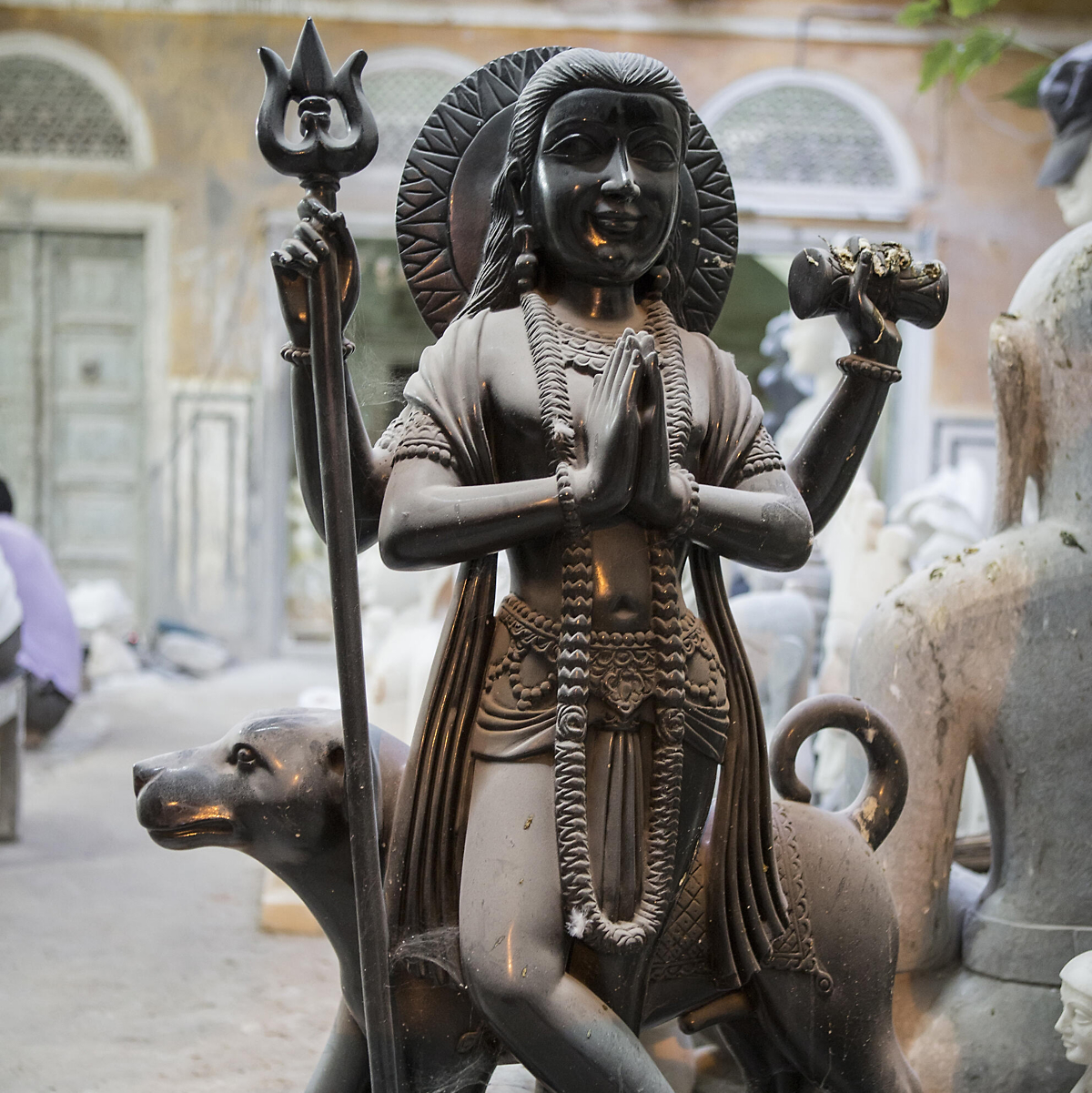
Statue of Hindu God Shiva Bhairav.
The presence of a dog alongside Bhairava serves multiple symbolic purposes. It represents Bhairava's role as a guardian of sacred spaces, symbolizes loyalty and devotion to the divine, and signifies the ability to confront and overcome fear (as dogs are known for their courage).
Yudhishthira's Faithful Companion
Another significant appearance of a dog in Hindu mythology comes from the epic Mahabharata. In the final book of this ancient text, the Pandava brothers and their wife Draupadi begin their final journey to heaven. As they ascend the Himalayas, one by one they fall, until only the eldest brother, Yudhishthira, and a stray dog that had joined them remain.
When Yudhishthira reaches the gates of heaven, he is told he may enter, but the dog must remain behind. In a testament to his virtue and compassion, Yudhishthira refuses to abandon his loyal companion, stating that it would be a great sin to abandon one who has shown devotion and loyalty.
"This dog is revealed to be Yama, the god of death, who took this form to test the truthfulness of Yudhishthira," says Narottam. This story emphasizes the Hindu values of compassion towards all beings and the importance of loyalty and dharma (righteous living).
Sarama: The Divine Hound
In the Rigveda—one of the oldest Hindu texts—we encounter Sarama. "The female canine is referred to as mother of all the dogs," says Narottam. Sarama is credited with finding the divine cows stolen by the Panis, a group of demons. This myth is often interpreted as a metaphor for the discovery of divine knowledge or the revelation of hidden truths.
Sarama's role as a messenger between gods and demons highlights the dog's position as a creature that can traverse different realms. This ability to move between worlds is a common attribute of dogs in various mythologies, not just Hindu.
Dogs in Hindu Rituals and Beliefs
While dogs play significant roles in Hindu mythology, their position in Hindu society and rituals is complex. In some traditions, dogs are considered sacred and are even worshipped during specific festivals. The Kukur Tihar festival in Nepal, which has Hindu roots, dedicates a day to honoring dogs with garlands and treats. "During Diwali, this day is a part of thanksgiving to dogs for their loyalty and protection," says Narottam.
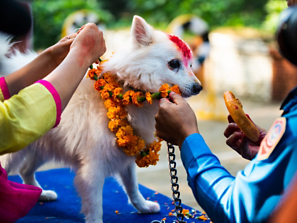
A dog being honored during Kukur Tihar.
Conversely, in some Hindu traditions, dogs are considered impure, possibly due to their scavenging nature. This has led to conflicting attitudes towards dogs in different Hindu communities. In Hindu astrology, the dog is associated with Shani (Saturn), a planet often linked with hardship and learning through challenges.
Dogs in Modern-Day Indian Culture
Because of dogs’ special association with the doors of heaven, it is still believed that mistreating one may have eternal spiritual consequences—because a dog, with its sharp memory, will recognize adversaries and turn them away. "Traveling through India, one sees stray dogs everywhere," says Narottam. "Most of them look well-fed."
Since growing up in rural India, he has experienced this belief firsthand. "As kids, we had a task to go out and feed stray dogs with a scrap or two of bread," he says. "Now, I live in a city, but this tradition still goes on. When we cook our bread for meals, the first piece is kept for a cow, and the last is kept for a dog."
The concept of dogs as pets, however, has yet to fully catch on. "It is a new thing in India," says Narottam. "But if we look at the large chunk of the rural population of India, all stray dogs are like their pets." Even in his city home, Narottam can appreciate this concept. "We have a stray dog around our house, and my son has been taking good care of him," he says. "They have a strong bond. The dog waits for my son at the gate when he gets home from school. My son named him ‘Moti.’"
The Enduring Legacy of Canine Companions
The role of dogs in Hindu mythology is multifaceted, reflecting the complex relationship between humans and these animals in Hindu culture. From divine companions to symbols of loyalty and dharma, dogs in Hindu myths often embody virtues that are highly valued in one of the world's oldest living religions.
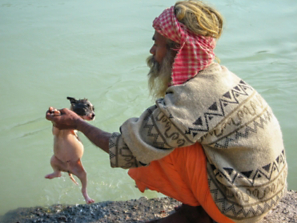
An Indian man washing his little puppy dog in the river Ganges.
"Dogs have been our friends since times immemorial," says Narottam. "Right from the times of human evolution when we transitioned from hunters and gatherers to settlers." In the end, these ancient tales serve as a powerful reminder of the connection between humans and dogs—a bond that transcends culture, time, and even the boundaries between the earthly and the divine.
During our Heart of India adventure, watch for dogs both on the streets and immortalized in statues.
The Heart and Soul of India Revealed
Read about one traveler’s journey through India as she learns about its dynamic culture and moving history.
A Traveler’s Confession
In Howie’s tale of love and pixels, he spills the beans on his not-so-secret affair with a stunning Japanese beauty.
Get The Inside Scoop On...
Like what you see here? Receive weekly updates right in your inbox.
inside-scoopArticles In This Edition

11 Special Departures by Land, Sea, and River for 2025

Dogs in Hindu Mythology: Loyal Companions and Divine Messengers

Hairless Heirlooms

Leader of the Pack

Scotland’s Fabled Fauna: Canines, Felines—and More!