Food Fight
Question: What iconic Sicilian culinary favorite has been at the center of a decades-long conflict between Palermo and Catania?
Answer: Arancini
It seems that few issues spark more heated debates than food. Like fiery Mount Etna, a culinary debate has been smoldering for centuries between Sicily’s two major cities, Palermo and Catania. It’s all about arancini, the deep-fried rice balls stuffed with savory ingredients like green peas, spicy meat, and cheese. For once it’s not the Mafia causing trouble, but an ongoing food feud over this iconic street food that’s threatening to divide the island in half. The root cause of the dispute is “gender,” but not in any “wokeness” sense. And the way those Sicilians can hold a grudge, it’s a dispute that won’t be ending any time soon …
So, what exactly is it about? When referring to the iconic fried rice ball, those living in Catania and other cities on the eastern side of Sicily use the masculine name of arancino—and when there are more than one, arancini. And residents of the western side like Palermo advocate for the feminine form, arancina—and the plural, arancine. You wouldn’t think so, but it’s a very big deal when a Sicilian prefers one gender over another.
Rice ball of confusion
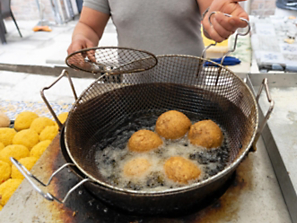
In Palermo, the shape of arancina still resembles the orange that inspired its name.
Bear with me here. With its golden appearance and round shape, the original iconic fried rice ball snack resembled a sour orange, a citrus imported by the Arabs between the 9th and 11th centuries. Because masculine nouns typically end in “u” in the Sicilian dialect, the rice balls were called arancinu, meaning a small, sour orange. But after Italy conquered Sicily, the name was “Italianized” to arancino.
Then, in the 15th century, Portuguese merchants arrived in the port of Palermo with sweet oranges, which they called laranja. Deciding that it would be better if arancinu reminded them of this nicer type of orange instead of sour ones, residents of Palermo and the surrounding areas changed the name from arancinu to the feminine arancina. But people in Catania didn’t get the memo, so the linguistic change never occurred on the eastern side of the island.
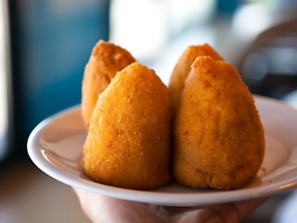
But it didn’t end there. The two coasts of Sicily began developing similar, yet different, types of arancini. In Palermo, they kept the original round shape of the tasty snacks but added saffron to the rice to preserve its Arab roots. But the ones in Catania started taking on the shape of a cone to resemble nearby Mount Etna. The Spanish had also introduced tomatoes to Sicily in the 15th century, but it wouldn’t be until the middle of the 19th century before both sides of the island began adding passata (tomato puree) to the original recipe that had been used since the Middle Ages.
While the rice balls were always called arancino and arancina, then, no one was really bothered by the gender differences. For centuries, it was no big deal. People only noticed the minor distinction through the spoken language. It wasn’t until the modern era and, really, the birth of social media when the trouble started. Criticisms began appearing regarding the two different genders of arancini and people began demanding linguistic clarity. And all of a sudden, as reported in the Italian magazine Internzionale, the arancini gender issue turned into “the mother of all Sicilian fights.”
Gender disagreement
For a while, it was thought that a linguistic intervention could settle the argument. Italy's language authority, the Accademia della Crusca, released a report in 2016 stating both forms are grammatically correct. Unfortunately, they went on to state that “the feminine version is slightly more correct.” So, instead of settling the debate, it just intensified it
The feminine/masculine of arancini continues to be a contentious issue among Sicilians. Some businesses have attempted to introduce gender-neutral terms or tried adopting the original Sicilian term, arancinu, but are being met with scorn. The best advice we can offer when you’re craving one of these savory rice ball snacks is not to say a word, just point …
A few more fascinating food feuds to digest
- A dip in Middle East tensions—Lebanon’s government petitioned the European Union to
classify hummus as a uniquely Lebanese food, complaining that it was being labeled in Western markets as
“Israeli cuisine.” The battle intensified when Israeli chefs made 9,000 pounds of the savory dip,
breaking the world record for the largest plate of hummus. Lebanon responded by making 23,000 pounds of it,
shattering the record once again. Israel then began selling postcards at kiosks around the country calling
hummus “Israel’s National Snack.” But there really can’t be a winner. The origins of
hummus can be traced to the time of Saladin in the 12th-century—long before the states of Israel and
Lebanon.
The absurdity of a feud over chickpeas was addressed in a fictional debate with Hamas by Sacha Baron Cohen, whose ditzy character Bruno asked: “Why are you so anti-hummus? Isn’t pita bread the real enemy?”
- Chile and Peru’s dispute is a real “hot potato”—Chile and Peru have
often quarreled over the naming rights to “pisco” but that’s just small potatoes compared to a
more recent feud. It began when a university scholar from Chile tried to register more than 280 potato varieties
from the southern island of Chiloe as originating in Chile. Chile’s agriculture minister then proclaimed
that “99% of the world’s potatoes have some type of genetic link to potatoes from Chile.” They
weren’t entirely wrong, as recent scholarship has confirmed a 90% genetic link of the potato to
Chile.
But Peru was having none of that. They insisted that potato’s “roots” are in the Andes near Lake Titicaca and threatened to take the case to the United Nations. It turned into a three-way fight when Bolivia then claimed to have found traces of older tuber in its soil, making the quarrel even worse. One village in Peru may have gone too far by recreating the popular tomato-throwing festival in Spain but replacing squishy tomatoes with potatoes—injuring dozens.
- Does Pavlova ring a bell?—No, it has nothing to do with salivating dogs. Pavlova is
meringue-based dessert at the center of a lengthy dispute between Australia and New Zealand—who each claim
to have originated this cloud-like confection topped with fresh fruit and whipped cream. A serious matter of
national pride, the only thing they do agree on is that was named after Anna Pavlova, a legendary
Russian ballerina who toured both Australia and New Zealand in the 1920s.
When the Australian National Dictionary described pavlova as “a famous Australian dessert, named due to its mouth-watering properties,” New Zealand’s prime minister dismissed it as “totally ridiculous.” The spat then went into the kitchen, with Kiwi college students creating a 200-foot-long pavlova, the world’s largest. So, of course, the Aussies came back with a 500-square-foot pavlova capable of feeding 10,000 people. The true origins are still murky. Meanwhile, both nations await their just desserts.
- Everyone’s cheesed off about this one—A battle over the origin of feta cheese
between Greece and the European Union raged for close to 20 years. It began because Greeks wanted feta to be an
official national product and have the exclusive use of the feta label. But Denmark, Europe’s second
largest feta cheese producer, had a problem with that. So did Bulgaria, who also made cultural claims to the
tangy cheese. The Netherlands and Germany cried foul as well. An issue of national pride and culture, the
long-running dispute ended up in court. Denmark and Germany argued that feta is a generic designation and does
not relate to a specific geographical area, but the EU court thought differently.
Following more than ten years of legal wrangling, the court made its final ruling: Feta is officially a Greek product and to call your cheese “feta,” it must be produced in a traditional way (from sheep’s milk or a mix of sheep’s and goat’s milk) on mainland Greece and the island of Lesbos. No one in Europe was happy except Greece. Canada didn’t like it much either. After four years of trade negotiations with the EU, Canadian feta producers learned they now must label their tangy cheese as “feta-style.”
- A dispute that was fermenting in Asia—South Korea and Japan were embroiled in a legendary
culinary dispute over kimchi, the spicy side dish made of fermented pickled cabbage, ginger, red pepper, and
garlic. It began in 1996, when Japan wanted to designate Japanese kimchi (called “kimuchi”)
as an official food of the Atlanta Olympics. South Korea was outraged, as this ersatz version of their beloved
national dish was made to suit Japanese tastes (it was less spicy and included artificial flavor additives), and
also because Japan was exporting more kimuchi at a lower cost than their kimchi. Korea then
petitioned the arm of the World Health Organization that deals with these things to establish an international
standard for kimchi.
Japan claimed that Korea has no monopoly on kimchi, but they misjudged how much this traditional food meant to the people of South Korea. A well-known Korean saying translates to “The taste of kimchi is the taste of your mother’s fingertips.” They even launched kimchi into space with the first Korean astronaut in 2008. And in 2013, UNESCO recognized Kimiang (the making and sharing of kimchi) as an Intangible Cultural Heritage of Humanity.
But the “kimchi wars” are not quite over yet. Tensions have flared up between China and South Korea in a dispute over China’s version of kimchi, called paocai. When you get between a country and their national dish, you’re asking for trouble—especially one that tastes like their mother’s fingertips ….
Sample both arancino in Catania and arancini in Palermo and take your own side in the rice ball debate during Sicily’s Ancient Landscapes & Timeless Cultures.
Related Articles
Destinations
Related Trips
- Sicily's Ancient Landscapes & Timeless Traditions
- Tuscany & Umbria: Rustic Beauty in the Italian Heartland
- Italy’s Coastal Charms: Naples, Ischia Island & the Amalfi Coast
- Amalfi Coast: Naples, Sorrento & Pompeii
- Jewels of the Sicilian Coast: Palermo, Siracusa & Mount Etna
- Northern Italy: The Alps, Dolomites & Lombardy
- French & Italian Rivieras: Avignon, Corsica, Elba & Rome
- Mediterranean Navigation: Malta, Sicily, Tunisia, Algeria, Morocco & Coastal Spain
- Alpine Europe: France, Italy's Dolomites, Switzerland & Austria
- Journey Through Southern Italy: Sicily, the Aeolian Islands, Calabria & Puglia
Get The Inside Scoop On...
Subscribe to The Inside Scoop
Like what you see here? Receive weekly updates right in your inbox.
Articles In This Edition