
Thekkady—located in the state of Kerala—is a resort and spice-trading town travelers can visit during our New! Soul of India: The Colorful South adventure.
Refer Friends & Earn Cash Rewards—Up to a FREE Trip.
Thekkady—located in the state of Kerala—is a resort and spice-trading town travelers can visit during our New! Soul of India: The Colorful South adventure.
Question: What Indian state—whose name means "land of coconuts"—is home to ancient churches, mosques, synagogues, and the world’s richest Hindu temple?
Answer: Kerala
Located at the southwestern end of the Indian Subcontinent, Kerala is one of the smallest states in India. Yet this narrow ribbon of land nestled between the Arabian Sea and the forested hills of the Western Ghats is widely hailed as India’s most magical corner. National Geographic Traveler even named it one of the "ten paradises of the world."
Some of what makes Kerala so uniquely special can be attributed to its unique geography, history, and climate—but that’s just the tip of the Subcontinent, so to speak.
India may be one country, but it’s really myriad countries—a melting pot of cultures, where language, customs, cuisine, temple architecture, and more can differ from one region to the next. The differences are especially striking between North and South India—which can partially be explained just by glancing at a map. North India is landlocked and sits beneath the mighty Himalayas—which influence its climate, making it a bit cooler and dryer than the rest of the country. South India, on the other hand, is surrounded by the Arabian Sea and the Indian Ocean, giving the entire region a more tropical climate.
When you combine Kerala’s tropical climate with its interconnected inland waterways formed by wild rivers flowing from the peaks of the Western Ghats, this small corner of India was blessed with a rich and fertile soil that few regions of the world could rival. It wasn’t just the "land of the coconuts," but the land of everything else, too—especially spices.
The spices of Kerala—cardamon, ginger, turmeric, and mostly pepper, so valuable it had become known as "black gold"—is what prompted the search for all-water routes to the Indies. Columbus took a wrong turn and ended up in the Bahamas, but his commercial rival, the Portuguese Vasco da Gama didn’t. After sailing around the horn of Africa, he made it here in 1498, setting off an era of exploration and conquest.
With some 360 miles of palm-fringed coastline hugging the Arabian Sea, Kerala’s geographic location would soon make it the epicenter of the world’s spice trade. But this was nothing new—Kerala had already been attracting merchants, fishermen, and settlers from across the Arabian Sea for some 3,000 years.
Kerala has always been a spicy symbol of religious coexistence
Unlike almost every other region of India (or, let’s face it, almost every other part of the world), most outsiders who arrived in Kerala throughout its long history were welcomed. Over the centuries, countless Jewish and Christian migrants, Arab merchants, and European traders (and colonizers), came to Kerala and well, never left. Evidence of this can be found in Kerala’s port city of Cochin (now Kochi), which is home to India’s oldest active synagogue and Europe’s oldest church, both from the 16th century.
As most of us are aware, there is big difference between religious tolerance and religious coexistence—and the world could learn a lesson from Kerala. While most of its once thriving Jewish population is gone, the small state remains home to a population split between roughly 30 percent Muslim, 20 percent Christian, and 50 percent Hindu. In many towns, it is not unusual to find a Hindu temple, Muslim mosque, Christian church, and Jewish synagogue within spitting distance of each other.
A good example of Kerala’s belief that religious differences don’t have to divide a community but can actually bring people closer together occurred in the summer of 2015. The local populace was gripped by an unfolding story that began when an Indian Navy helicopter dispatched to transport the heart of a Hindu man for a Christian patient who was in dire need of a transplant. Funds were raised by a Muslim businessman to pay for the operation, which was then performed by Kerala’s top heart surgeon, who was a Christian.
But Kerala’s history of religious coexistence doesn’t begin to touch upon the special nature of this tiny Indian state. There are two geographical features that make Kerala really stand out from the crowd, the first of which doesn’t sound very romantic at all …
Bliss in the backwaters of Kerala
Admittedly, the "backwaters of Kerala" is a rather unappealing name for such an idyllic tropical paradise—but the name has stuck. The "backwaters" are actually a vast and serene network of interconnected lagoons, lakes, rivers, and canals that weave through lush greenery before flowing into the Arabian Sea. Visually stunning, gliding along these tranquil waters takes you past lush landscapes dotted with coconut palms, rice paddies, small fishing villages, men in plaid dhotis and women in brightly colored saris, and all manner of vibrant flora and fauna.
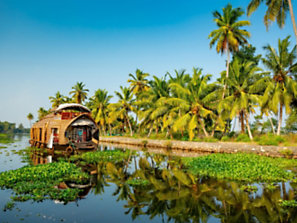
Thatched-roofed houseboats called kettuvallam have been plying these labyrinthine waterways for thousands of years, laden with coconuts, spices, and grain. Kerala’s beautiful backwaters are also one of the only places in the world—outside of the Netherlands—where land is cultivated below sea level.
Not that it needs anyone to vouch for its special nature, but when the then-Prince Charles wanted a place to celebrate his 65th birthday, he brought his wife Camilla and an entourage to a lakeside retreat in the backwaters of Kerala.
As mentioned, the backwaters are just one of the geographical features that distinguishes Kerala. This narrow ribbon of land is hemmed in by the Arabian Sea to one side, but what’s on the other side is where the true paradise lies …
All Quiet on the Western … Ghats
Forming a natural barrier between Kerala and the neighboring state of Tamil Nadu, the Western Ghats (another name that’s a bit of a headscratcher) is an ancient mountain range of breathtaking natural beauty and rich biodiversity—so much so that it’s recognized by UNESCO as a World Heritage Site. Along with mist-covered peaks, the Ghats are home to rugged hills and lush valleys dotted with emerald-green tea plantations, fragrant spice plantations, picturesque hill stations, cascading waterfalls—and wildlife sanctuaries teeming with tigers, leopards, exotic bird species, and herds of wild elephants.
Speaking of elephants, Kerala is home to at least 7,000 wild elephants and about 700 domesticated ones—the largest number in India. It’s a rare day when you don’t see an old tusker rambling along a dusty road. And since most temple festivals in Kerala require the presence of an elephant, almost every temple has their own elephant. Until recent times, it was prestigious having an elephant in your home—or shared between the homes of the two or three mahouts responsible for their feeding and care. Although costly to maintain, you were looked upon as pretty well off if you had an elephant at your house—perhaps the modern-day equivalent of spotting a luxury sports car parked in someone’s driveway.
It should be noted, however, that with increasing awareness of the ethical treatment of animals, the days of using live elephants in Kerala temple ceremonies may soon be over. After one temple recently employed an 11-foot mechanical elephant crafted from an iron frame and weighing in at close to 2,000 pounds, others are planning to follow suit.
About those temples … India is home to close to 500,000 opulent temples, many of them repositories of staggering wealth. But Kerala’s Sri Padmanabhaswamy Temple—dedicated to Lord Vishnu—is in a league of its own. Not all of its recently discovered secret vaults have even been opened yet, but the gold ornaments, statues, and precious stones recovered so far are estimated to be worth a trillion dollars—making it not just the richest temple in India, but in the entire world.
8 more fascinating facts you may not know about Kerala:
Explore Kerala during our New! Soul of India: The Colorful South adventure.
Rags to Riches
Which former refugee haven has transformed into one of the world's most expensive retail locations?
Where in the World?
Where can you find 12 towers carrying thousands of gods and monsters, dedicated to a warrior goddess who gets a divine nightly visitor?
Where in the World?
Where in the world is this ancient royal hunting ground, now repurposed into a diverse wildlife sanctuary for the resurgence of tiger populations?
Get The Inside Scoop On...
Like what you see here? Receive weekly updates right in your inbox.
inside-scoopArticles In This Edition

"Mrs. Harriet" and Minh Tu Orphanage: A Meeting 20 Years in the Making

All That Glitters Isn’t Gold: Thailand’s Silver Temple

All the Ways to See Asia with O.A.T.

Baby’s Got Backwaters

Express Yourself

Small Groups, Big Moments: Yvonne Hunter's Heart of India Adventure

Vacation Ambassador Traveler Spotlight: Marsha and Bill Johns