
San Carlos de Bariloche, or "Little Switzerland," is surrounded by astonishing natural beauty thanks to unspoiled forests, crystalline lakes, and soaring peaks—which travelers can visit during our Chile & Argentina: The Andes to Patagonia adventure.
Refer Friends & Earn Cash Rewards—Up to a FREE Trip.
San Carlos de Bariloche is a quaint mountain town that makes most travelers wonder whether they’ve accidentally hopped upon a plane headed to Switzerland. While the locals just call this picturesque lakeside village "Bariloche," there’s a reason it’s earned the nickname of "Little Switzerland" amongst travelers far and wide.
Located in the southern part of Argentina, occupying the northern Patagonia region, and nipping at the ankles of the Andes, Bariloche is strung out along the shoreline of a crystalline glacial lake named Lago Nahuel Huapi. From the Alpine-inspired architecture to the locally brewed beers, the influence of German culture is unmistakable in this South American community. However, as O.A.T. Trip Experience Leader Marta Marta reveals, the story of German settlement in Argentina is as complex as it is fascinating.
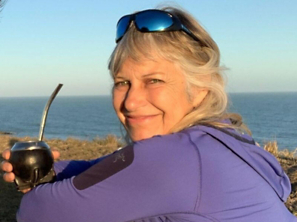
Marta has been an O.A.T. Trip Experience Leader for our Chile & Argentina: The Andes to Patagonia adventure since 2016.
"The first German settlers started arriving in Argentina in several waves of immigration since 1853," Marta explained. "Our Constitution encouraged European immigration up to the point that between 1870 and 1950, the percentage of immigrants living in our country was even higher than in the U.S."
According to Marta, who is herself of German heritage, these immigrants were often fleeing conflicts in Europe, including the wars that led to the formation of the German Empire in 1871, as well as both World Wars. Many were drawn to Bariloche specifically, attracted by its natural beauty.
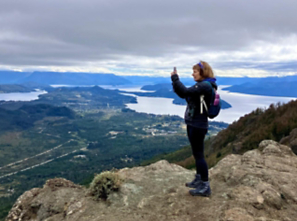
Marta taking in the natural beauty of Bariloche.
"In many cases, they were attracted to Bariloche by relatives that were already living here and also by the beauty of the landscape that reminded them of the Alps and the Black Forest in Germany," Marta said. She added that the Argentine government offered incentives to encourage settlement, including "tools and land in Patagonia so that they could start their farms and milking yards."
The German settlers brought with them not only their agricultural expertise but also their passion for outdoor pursuits. "They were the ones that built the first skis as well as shelters on strategic trails that are still operating," Marta noted. She highlighted the contributions of Otto Meiling, a German immigrant who founded the Mountaineering Club in Bariloche (CAB) and is still "beloved by many generations."
However, the story of German settlement in Argentina is not without its dark chapters. Marta acknowledged the displacement of indigenous peoples that preceded the arrival of European settlers. "After many battles, and after a process that the army called 'The Campaign to the Desert', many of our native people were killed, some of them crossed to Chile, and others were sent to Buenos Aires in conditions that can be compared to slavery," she said. "It is a very sad part of our history."
Perhaps the most controversial aspect of German immigration to Argentina is the arrival of Nazi war criminals following World War II. Marta addressed this sensitive topic, explaining how she approaches it with travelers: "During our stay in Bariloche, we have a lecture given by a member of the German community who shares with our travelers her story and discoveries about the Nazi presence in Bariloche."
Marta emphasized the importance of nuance when discussing this history. "As the daughter of a German immigrant and because the Nazi topic is already addressed, I prefer to focus on the fact that not all of the Germans that came were Nazis," she said. "Bariloche received Germans coming to work the fields... Also during and after World War II, many Jewish people looked for shelter here."
The complexity of this history is further illustrated by Marta's own family story. "After living all her life as a Christian—even telling me off if I didn't go to church and sending me to a Catholic school—we discovered that [my mother] was Jewish, once she had already passed," Marta revealed.
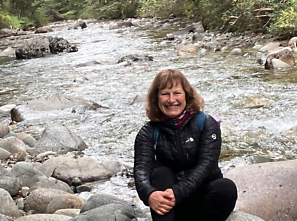
Marta’s family came to Bariloche from Germany many years ago.
Argentina's official stance during World War II was one of neutrality, though Marta noted that this wasn't entirely accurate. "While Juan Perón was President, many Germans and scientists from eastern countries got passports to come to Argentina, and as he was close to Mussolini, he was considered to be a fascist and many Nazis took the chance to come in those days," she explained. In Bariloche specifically, the German community maintained what Marta called a "pact of silence" regarding the presence of Nazi fugitives, which provided them with additional protection.
In fact, Bariloche gained world-wide notoriety in the 1990s when it was revealed that Nazi war criminal Erich Priebke had been living there openly for decades. When asked how Bariloche has come to terms with this controversial part of its history, Marta admitted that there's still progress to be made. "We don't talk much about it," she said, referring to the town's Nazi connections. "Most of the society are happy about Priebke being captured, but I'm sure there are still some that wouldn't mind if there were Nazis around us."
Despite these challenging aspects of its history, German cultural influences continue to enrich life in Bariloche and throughout Argentina. While Bariloche itself doesn't host an Oktoberfest celebration, the city does hold an annual Communities Fest, celebrating the 12 foreign communities that make up its diverse society.
German culinary traditions also remain popular. "The most typical dishes are Sauerkraut, leberwurst, Bratwurst with Kartoffelsalat (potato salad), smoked trout, and the delicious Schwarzwälder Kirschtorte (Black Forest cake)," Marta shared.
As Argentina grapples with current economic and political challenges, the complexities of its immigrant history may not be at the forefront of public discourse. However, Marta believes there's always room for improvement in how society addresses its past and present. "In my opinion, there are many things we should work on," she reflected. "Maybe this time is not about the Nazis, but we could improve our levels of tolerance towards different opinions, and we should take better care of our native people."
Visit Bariloche during our Chile & Argentina: The Andes to Patagonia adventure.
Ros and Sue’s Excellent Adventure
Primed to discover the Andes & Patagonia, two travelers also made a rediscovery that you’ll have to read to believe.
Tango in the Rain
This traveler details his mesmerizing experience watching—and also performing—the tango in Buenos Aires.
Don’t Cry for Me Argentina: A Few Quiet Moments with Evita
Standing at her grave in Recoleta Cemetery, a traveler contemplates Evita’s life and legacy.
Get The Inside Scoop On...
Like what you see here? Receive weekly updates right in your inbox.
inside-scoopArticles In This Edition

8 Fall Festivals Around the World

Date Night

From Child Bride to College Grad: An Update on Flora, a Maasai Student

German Heritage in Argentina: A Complex Legacy

Visit the Adriatic in the Autumn and Winter to see Stunning Colors and Sights

Where in the World?